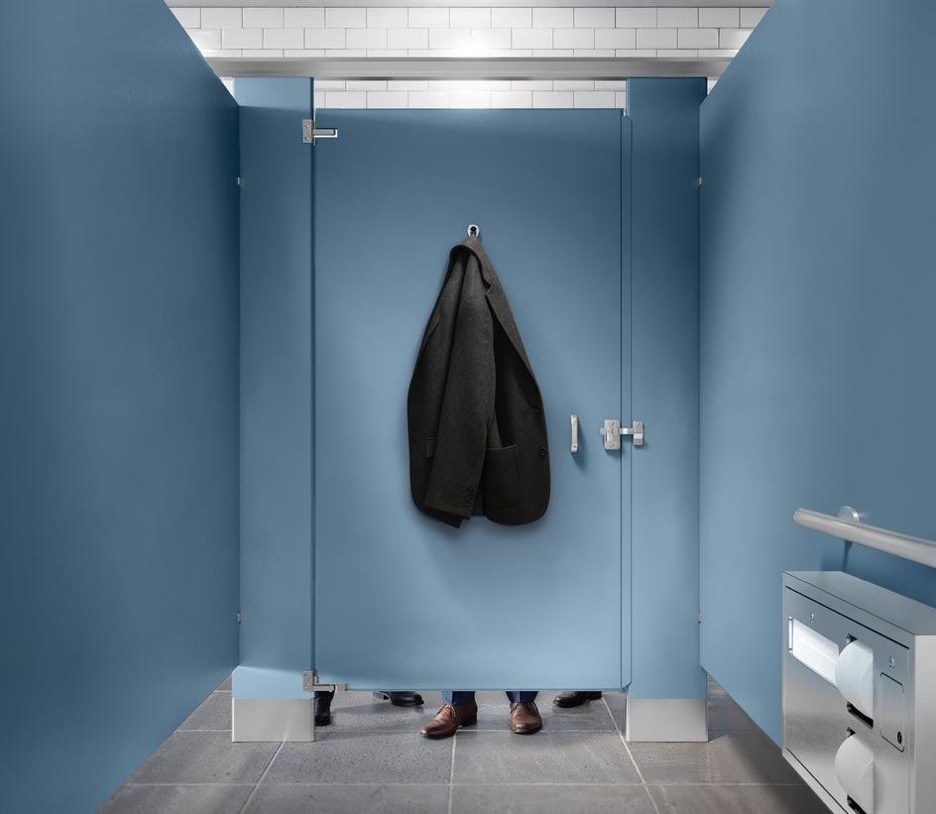
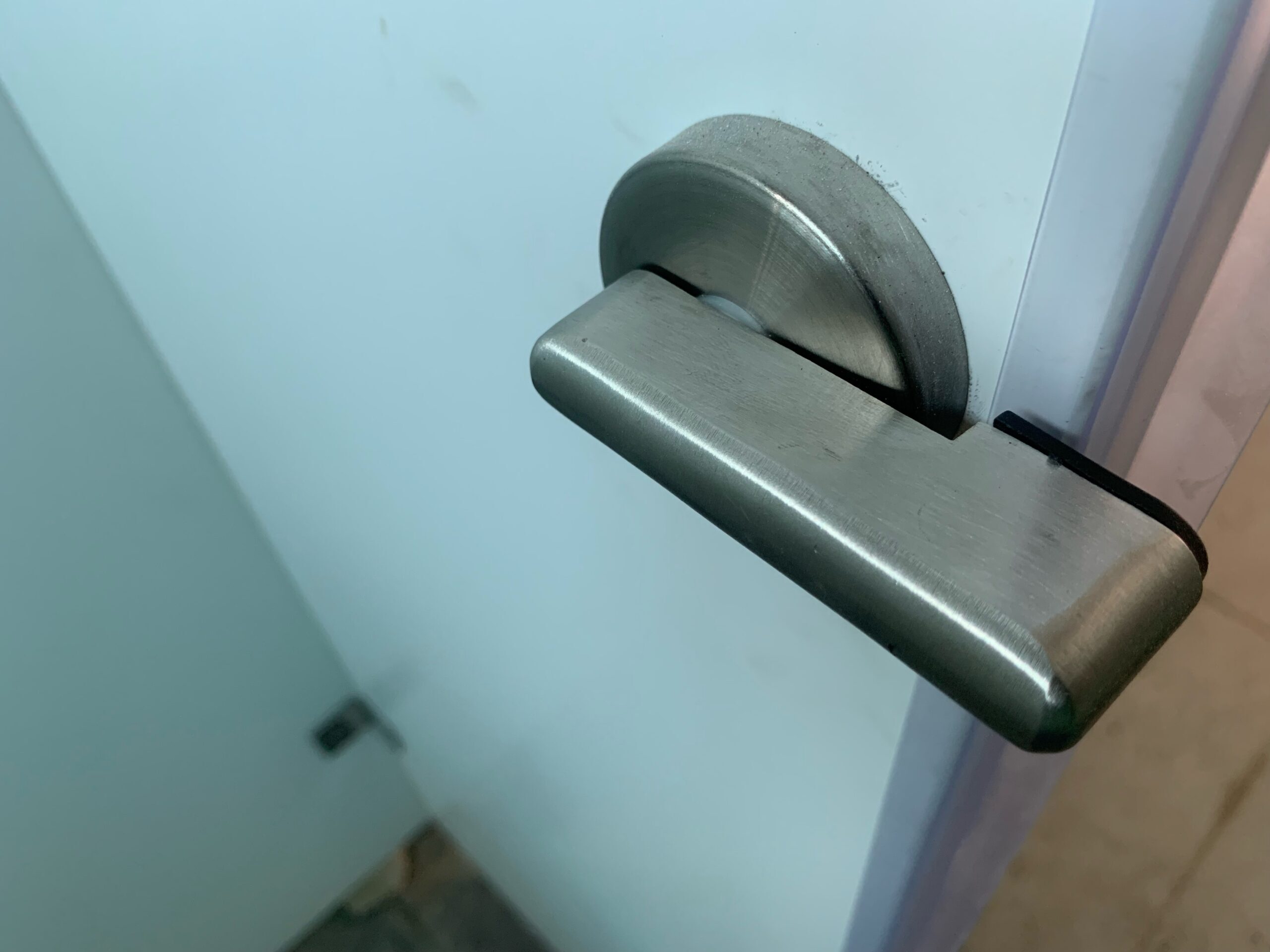
Executive Summary
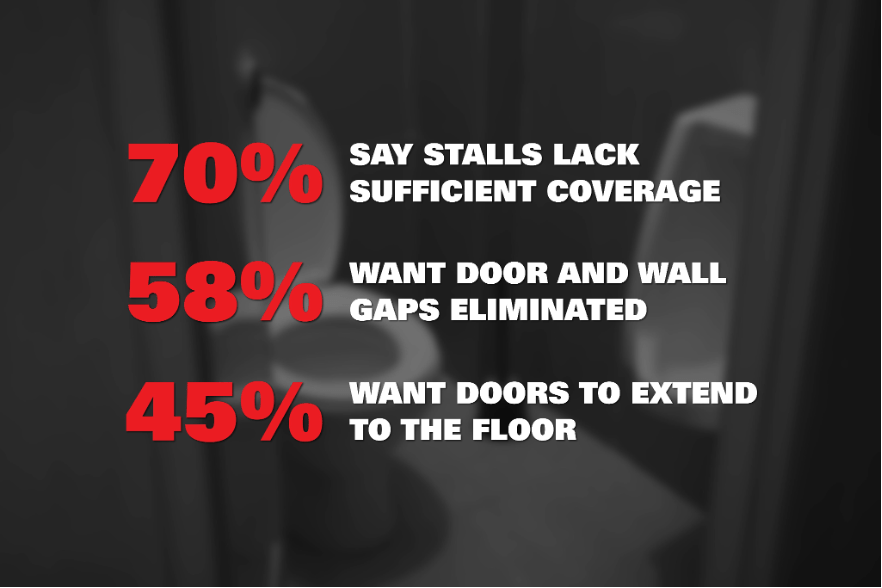
American restroom stalls have been designed with visible gaps between the door and pilaster on both the hinge and latch sides. These gaps have been a feature of U.S. commercial restroom construction but have become a source of public complaint. 70% of Americans report that public restroom stalls lack sufficient coverage, and 58% specifically want the gaps around stall doors and walls eliminated.[1]
A separate 2025 national poll found that 72% of Americans feel anxious about privacy in public restrooms, with 53% explicitly calling for the elimination of door gaps.[2] Taken together, this data reflects a consistent and growing expectation for better restroom privacy that spans demographics and building types.
This report examines how American restroom stalls arrived at their current design, what survey data reveals about occupant expectations, how building codes are responding, the limitations of retrofit solutions, and how integrated specification systems such as ASI’s proprietary Integrated Privacy™ System are redefining the standard for high-privacy toilet partitions.
Section 1: Why American Restroom Stalls Have Gaps
A Manufacturing Legacy, Not a Design Choice
The gaps in American restroom stalls are not the result of deliberate privacy decisions. They are a byproduct of modular manufacturing and field installation tolerances that have been standard practice in U.S. commercial construction for more than a century.
Commercial toilet partitions in the United States are mass-produced in standard panel widths. Doors, pilasters, and panels are manufactured at a factory and shipped to a jobsite, where installers assemble them between walls that may not be perfectly plumb, level, or square. The gaps on the hinge side and latch side of the door exist to allow the door to swing freely without binding against the pilaster. The gap at the bottom of the panel exists to simplify cleaning and to provide visible occupancy indication.[3]
This modular system gained dominance because it is fast to manufacture, inexpensive to ship, and forgiving to install. Architect Frank Lloyd Wright is credited with pioneering some of the earliest off-the-floor partition designs in the Larkin Building in Buffalo, New York, completed in 1906, where maintenance access and airflow took priority over occupant privacy. That foundational approach has defined the U.S. market ever since.
Why European Stalls Are Different
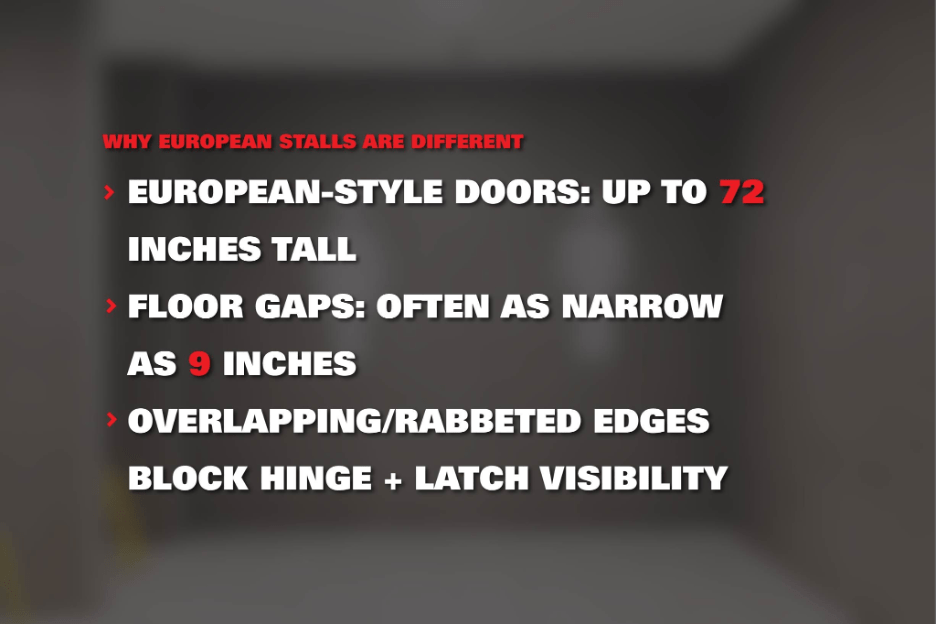
Visitors from outside the United States are frequently surprised by the visibility of American restroom stalls. European commercial restrooms typically use cubicle systems with full-height doors that minimize or eliminate sightline gaps entirely.[4] European-style partitions feature taller doors paired with smaller floor gaps and use rabbeted or overlapping door edges that block visibility on the hinge and latch sides.[5]
The difference is not primarily cultural. It is structural. European restroom construction has historically used fixed cubicle systems built into the restroom rather than modular partition panels assembled from prefabricated components. This approach increases material cost and installation time but delivers a fundamentally different privacy experience.
A Market Built on Speed and Efficiency
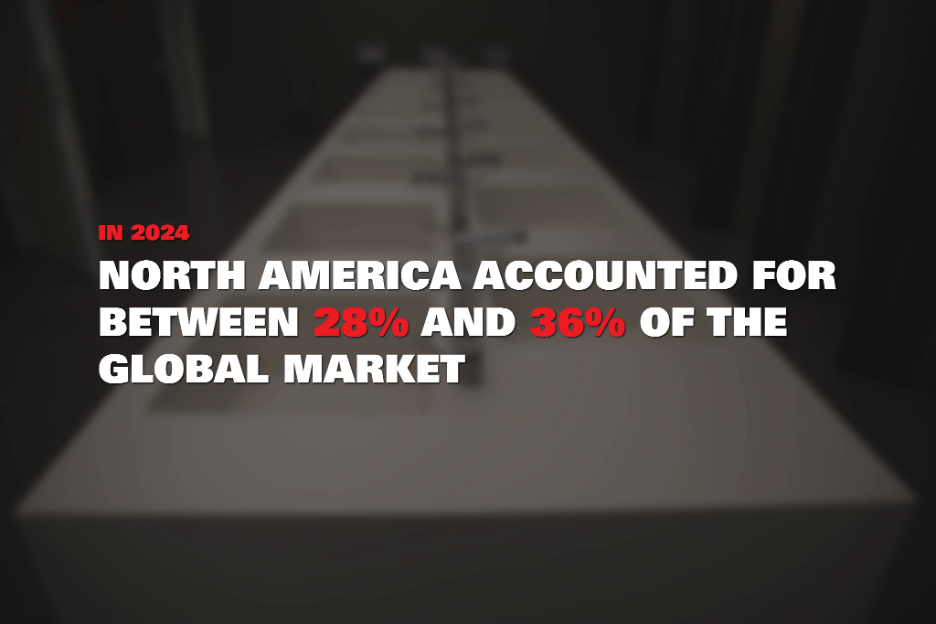
The U.S. commercial partition market is a multi-billion-dollar segment, with North America representing one of the largest regional shares globally.[6][7] The modular partition system that emerged was built around speed of installation and broad accessibility, values that defined commercial construction for decades and continue to shape how partitions are manufactured today.
The resulting system is efficient, affordable, and fast to install, but it can leave gaps that are immediately visible to anyone using the restroom.
Section 2: What the Data Says About Restroom Stall Privacy
National Survey Data
The most comprehensive public data on restroom privacy preferences comes from the Healthy Handwashing Survey, conducted annually since 2009 among more than 1,000 U.S. adults. The 2024 edition found the following:[1]
- 70% of Americans feel public restroom stalls lack sufficient coverage
- 58% want the gaps around stall doors and walls eliminated
- 45% want stall doors that extend all the way to the floor
- 96% believe visual occupancy indicators on stall doors would be helpful
- 74% of women reported having to use their foot to hold a non-working stall door closed
- 40% of respondents choose the stall farthest from the entrance
- 35% are annoyed when someone selects the stall next to theirs when others are available
A separate 2025 poll corroborated these findings, reporting that 72% of Americans report a lack of adequate privacy in public restroom stalls, with 53% supporting the elimination of door gaps and 45% preferring doors that extend to the floor.[2]
Facility Impact
ASI’s Marketing Director, Marco Gaebel, has noted that restroom quality plays a measurable role in how consumers perceive a business. For facility managers and building owners, this means restroom privacy is not merely an aesthetic consideration. It is an operational factor that influences foot traffic, tenant satisfaction, and brand perception.
Section 3: Building Codes Are Catching Up
Codes and Accessibility
The 2021 International Building Code introduced a significant update to restroom privacy standards, requiring that public restrooms be visually screened from outside entry or exit doorways and addressing mirror placement to prevent reflections from compromising personal privacy.[10] The update signals a broader regulatory trend toward treating restroom privacy as a code-level requirement rather than an optional amenity.
ADA guidelines also require that restroom compartments provide adequate privacy while maintaining full accessibility for users with disabilities, including sufficient clear floor space for wheelchair maneuverability.[11][12] Integrated privacy solutions are well-suited to meet both objectives, since building privacy components directly into the partition door, rather than adding physical obstructions to the stall interior, delivers full privacy performance without compromising accessibility clearances.
Section 4: The Retrofit Problem
Privacy Strips: A Field Fix, Not a Design Solution
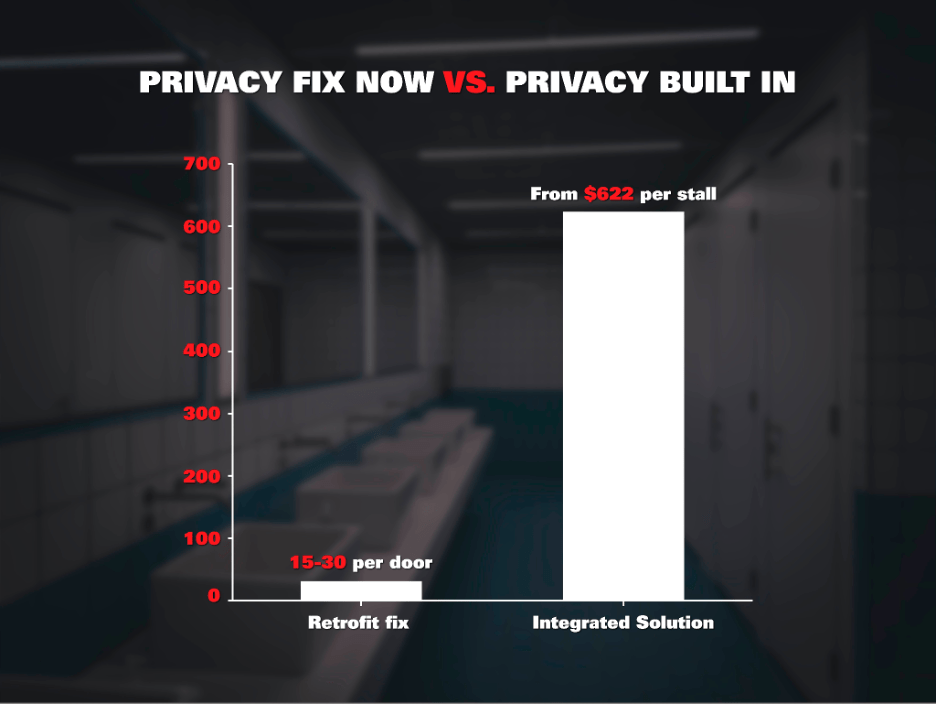
The most common response to sightline gaps in existing restroom stalls is the aftermarket privacy strip. These are aluminum or vinyl strips designed to be surface-mounted over the gap between the door and pilaster. They are widely available from partition hardware suppliers and can be quickly installed per stall.[13]
Privacy strips address the symptom, but they introduce their own problems. Retrofit strips are not color-matched to the partition. They are surface-mounted with adhesive or screws, creating a visible seam. They wear, peel, and discolor over time. In high-traffic environments such as airports, stadiums, and schools, they frequently need replacement.
Why Specification Beats Retrofit
Factory-integrated privacy components are part of the partition itself and designed to last for its full service life, removing privacy from the ongoing maintenance cycle entirely. For specifiers and facility teams, this shifts privacy from a recurring task to a one-time design decision.
Section 5: The Specification-Level Solution
ASI’s Integrated Privacy™ System
In August 2021, ASI launched the industry’s first Integrated Privacy™ system for metal partitions. Unlike retrofit privacy strips that are added after installation, the Integrated Privacy system is engineered into the partition door at the factory. Privacy components are built in, color-matched, and manufactured as a single unit, eliminating the need for field retrofitting.[15]
The system’s built-in privacy components completely close the gap on the latch and hinge side of the door to guarantee zero sightlines into the stall.[15] All stainless steel and powder-coated steel partitions from ASI now come standard with the Integrated Privacy system.[16]
At launch, ASI Group explained the design philosophy: the system was designed to meet an occupant’s need for total privacy while also being more aesthetically pleasing than retrofitted privacy components that do not match the stall.[15]
Ultimate Privacy™: The Full-Height Option
The Integrated Privacy™ System establishes zero sightlines in standard-height metal partitions, and ASI extends that same integrated privacy approach into taller configurations through its Ultimate Privacy™ line. For projects requiring maximum privacy, Ultimate Privacy™ builds on the integrated metal privacy foundation with taller doors featuring continuous strike and hinge side fillers, panels mounted lower to the floor to reduce the floor gap, and self-closing overlapping doors that meet the pilaster in a flush finish.[17]
Ultimate Privacy™ is available in metal and phenolic (both black core and color-thru), and delivers the zero-sightline design with occupancy indicator latches and emergency access capability.[17]
Maximum Privacy®: True Floor-to-Ceiling Coverage
For projects where privacy demands require a true floor-to-ceiling solution, ASI’s Maximum Privacy® is one of the only full-height partition systems in the industry that is floor-to-ceiling. This effectively eliminates sightline vulnerability at the top of the stall. Maximum Privacy® is available in phenolic, making it a strong specification choice for high-end commercial, institutional, and hospitality projects where both aesthetics and privacy performance are non-negotiable.
Specification Advantages
For architects and specifiers, the distinction between retrofit and integrated privacy is significant. Integrated Privacy partitions offer several specification-level advantages:
- Zero sightlines: Built-in components eliminate gaps on both hinge and latch sides at the factory
- Color matching: Privacy components are manufactured as part of the door, ensuring consistent finish
- No field retrofit: Eliminates labor, material, and maintenance costs associated with aftermarket strips
- ADA compatibility: Zero-sightline design does not reduce clear floor space or obstruct accessibility clearances
- Hygiene: Fewer gaps and seams reduce areas where dirt, moisture, and bacteria accumulate
- Broad availability: Integrated Privacy is standard across ASI’s stainless steel and powder-coated steel partition lines, with options spanning a range of budgets and applications
Section 6: Market Outlook
A Growing Market with a Privacy Mandate
The global toilet partition market is on a steady growth trajectory, with North America representing one of the largest markets.[6][7][18] An industry analysis noted that integrated restroom design packages, which include privacy-enhanced partitions, matching wall panels, and coordinated accessories, saw a 12% increase in demand in 2024 across commercial, institutional, and hospitality projects.[19]
The convergence of consumer demand data, building code updates, and manufacturer innovation reflects a clear shift in occupant expectations around restroom privacy. For architects, facility managers, and building owners, addressing restroom stall privacy is increasingly a baseline expectation rather than an upgrade.
Conclusion
American restroom stalls have gaps because of a manufacturing and installation system established more than a century ago, when modular partitions delivered the speed and broad accessibility commercial construction required. Occupant expectations have since evolved, and the partition industry has evolved with them.
The data is clear. Seventy percent of Americans report that their restroom stalls lack sufficient coverage. Fifty-eight percent want the gaps eliminated. Building codes are beginning to require visual screening. And the partition industry has responded with solutions that address the problem at the specification level rather than in the field.
ASI’s Integrated Privacy™ System represents the first factory-integrated zero-sightline solution for metal partitions, and the company’s broader lineup, including Ultimate Privacy™ and Maximum Privacy®, extends that commitment across a range of project types, budgets, and privacy requirements. For specifiers and facility managers, these solutions meet both occupant expectations and evolving code trends, without requiring full-height cubicle construction or European-style partition systems.
The privacy gap in American restrooms is not a permanent condition. It is a specification decision. And the specification options now exist to close it.
Works Cited
[1] Bradley Corporation. “Healthy Handwashing Survey.” 2024. Survey of 1,003 U.S. adults, January 2024. Published via PR Newswire, February 21, 2024.
[2] National poll reported by KDWB/iHeartMedia and other outlets, March 2025. Survey finding: 72% of Americans report a lack of adequate privacy in public restroom stalls.
[3] American Restroom Association (ARA). Restroom design standards and occupancy signaling guidelines.
[4] Scranton Products. “Embracing European Restroom Design Trends.” October 2023.
[5] Ironwood Manufacturing. “Understanding European Bathroom Partitions.” Industry guide.
[6] Arizton Advisory & Intelligence. “Restroom Partitions Market Size & Share, Demand, Trends.” Global market valued at USD 2.50 billion in 2023, projected to reach USD 3.64 billion by 2029, CAGR 6.46%. Report period 2024–2029.
[7] DataIntelo. “Restroom Partition Market Research Report 2033.” Global market size USD 2.45 billion in 2024, North America approximately 28% share (USD 0.68 billion).
[8] Partition King. “How Much Do Bathroom Partitions Cost? #1 Pricing Guide.” Industry pricing reference for commercial restroom partition materials and installation.
[9] The Mercury. “Why the U.S. Needs to Close the Gap!” March 2023. Citing IKEA survey of 12,500 Americans: 68% cited private restroom area as a main appeal of working from home.
[10] International Code Council (ICC). “Significant Changes to Restroom Privacy in the 2021 International Building Code.” Section 1210.3. Published October 2024.
[11] Illinois Building Code 2021, Chapter 12, Section 1210.3.1. “Each water closet utilized by the public or employees shall occupy a separate compartment with walls or partitions and a door enclosing the fixtures to ensure privacy.”
[12] U.S. Access Board. “Chapter 6: Toilet Rooms.” ADA Standards for Accessible Design, guidance on clear floor space, partition placement, and accessibility requirements.
[13] TPH Supply. “Bathroom Partition Door Privacy Strip Kit 650-1010.” Product listing for commercial restroom door privacy strip kit.
[14] TotalRestroom.com. “Stainless Steel Toilet Partitions.” Product and specification reference for stainless steel commercial restroom partitions.
[15] Learning By Design Magazine. “ASI Group Introduces Its Proprietary, Integrated Privacy™ System for All Metal Partitions.” August 18, 2021.
[16] ASI Global Partitions. “Powder Coated Steel” product page. Integrated Privacy™ System now standard in all stainless steel and powder-coated steel partitions.
[17] ASI Global Partitions. “Ultimate Privacy™” product page. Full-height partition configurations with Integrated Privacy™ System, phenolic construction options, and occupancy indicator latches.
[18] The Business Research Company. “Toilet Partition Market Size, Share, and Trends Analysis, 2025 Global Market Report.” Market projected to increase from $2.29 billion in 2024 to $2.98 billion by 2029, CAGR 5.3%.
[19] MarketReportsWorld. “Toilet Partitions Market Share & Trends [2033].” Integrated restroom design packages saw 12% increase in demand in 2024.